

Testimonials

Monolec Turbine Oil significantly improved oil demulsibility and reduced foaming in a Pennsylvania power plant turbine.

key takeaways

Challenge
Larry Boyle, a lubrication consultant, suggested that instead of draining all turbine oil to address demulsibility issues, adding 20% of LE’s Monolec Turbine Oil (6461) could improve the situation, which was confirmed by lab tests.
LE solution
During the April 2011 plant outage, adding Monolec 6461 to the turbine sump reduced foam and demonstrated its varnish removal capability by causing turbine basket screens to plug with varnish particles, necessitating cleaning.
Results
The addition of Monolec 6461 to Chevron GST 32 improved oil demulsibility and reduced makeup oil needs by at least 50%, avoiding costly oil changes and helping the station meet budgetary goals.
The addition of LE 6461 allowed the station to meet budgets because we did not have to perform a wholesale change out of the oil in order to restore the turbine oil to acceptable levels of demulsibility and foaming.
- Plant Engineer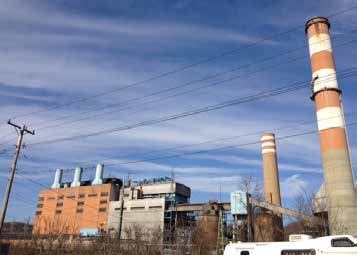

Customer Profile
This power plant generates 250 megawatts per day. It has been in business since 1948 and an LE customer since 2010.

Application
The plant uses a Westinghouse non-geared turbine commissioned in 1963 with an oil capacity of 7,000 gallons. The turbine system has a Bowser oil filtration system.

Challenge
According to oil analysis, demulsibility issues had been occurring since as early as 2008. Operations personnel were thinking of draining the turbine oil and installing new Chevron GST 32. Larry Boyle, LE lubrication consultant, suggested that draining all the oil might not be required and that an oil compatibility test should be run. He said that draining some of the turbine oil from the reservoir and replacing it with LE’s Monolec Turbine Oil (6461) may restore demulsibility and actually improve the condition of the oil.
As the demulsibility problem persisted, the plant engineer allowed Larry to pull samples and test the Chevron GST 32. Testing by the LE lab in September 2010 confirmed the plant’s ASTM D1401 demulsibility numbers, revealing a failing result of 7/24/49 after 30 minutes, a 49 mil water/oil emulsion, even though the plant had been adding makeup oil at a rate of 15 percent sump volume annually. The compatibility testing between the Chevron oil and Monolec 6461, by the LE lab, revealed that a 20 percent addition of Monolec 6461 to the turbine system could improve the demulsibility issue.
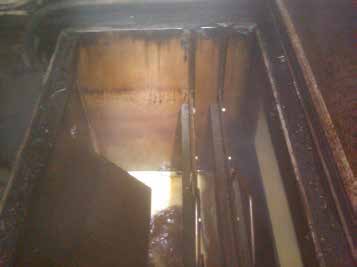
In December 2010, a significant head of foam was reported at the Bowser oil return line in the turbine lube sump. Add oil alarms started sounding due to the foaming and were becoming more frequent and bothersome. By April 2011, the foam had reached a critical level of 12 to 14 inches high (see picture with the dark foam stain line). Something had to be done.

LE Solution
During the plant outage in April, 2011, the plant engineer ordered enough Monolec 6461 to result in a 20 percent addition of the LE oil to the turbine sump. Monolec 6461 was added after 20 percent of the Chevron oil was drained.
Upon unit startup a couple of weeks later, the foam was almost gone (as the same picture reveals). As a sign of the solvency and varnish removal capability of Monolec 6461, the turbine basket screens plugged up with varnish particles for a few weeks and required cleaning after Monolec 6461 was initially added.

Results
Oil testing in June 2011 revealed oil demulsibility was restored to a pass of 40/40/0 in 15 minutes. Further testing in May 2012 revealed a further improvement to 40/40/0 in just 10 minutes. As more Monolec 6461 has been added to the Chevron GST 32, now roughly 35 percent of sump volume, the amount of makeup oil required has been reduced by at least half – a significant improvement. Oil foaming has remained minimal. During the March 2013 outage, an inspection of the servo motors on the turbine valves revealed no appreciable dirt, rust or sludge/varnish deposits, and there was no evidence of water pockets.
“The addition of LE 6461 allowed the station to meet budgets because we did not have to perform a wholesale change out of the oil in order to restore the turbine oil to acceptable levels of demulsibility and foaming,” said the plant engineer. “It really came through for us and solved a serious issue. LE is the best.”