

Testimonials
Alaskan oilfield services company significantly reduces Rolligon bearing failures using Almaplex® Ultra-Syn Lubricant.

key takeaways

Challenge
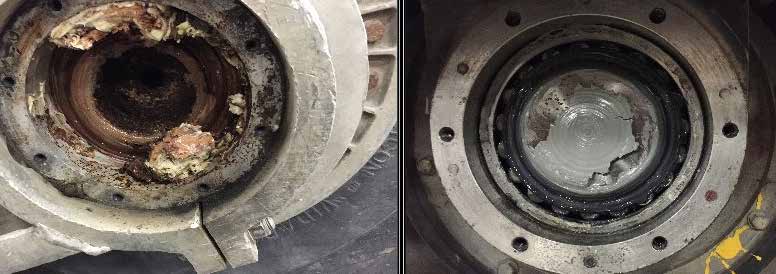
Rolligon roller bearings in Alaska failed due to harsh conditions and the use of mineral grade lithium thickened NLGI 2 EP grease, which waxed up in freezing temperatures, causing lubricant degradation and contamination by dirt and moisture.
LE solution
SKF states that removing particles larger than the lubricant film can extend bearing life indefinitely, while using the right lubricant like Almaplex® Ultra-Syn Lubricant (1298) can reduce bearing failure and save on costly labor and downtime.
Results
Switching to LE’s Almaplex 1298 lubricant reduced roller bearing failures by 73%, saving the company approximately $196,200 annually in parts, labor, and downtime costs.
Bearings can have an infinite life when particles larger than the lubricant film are removed.
- Skf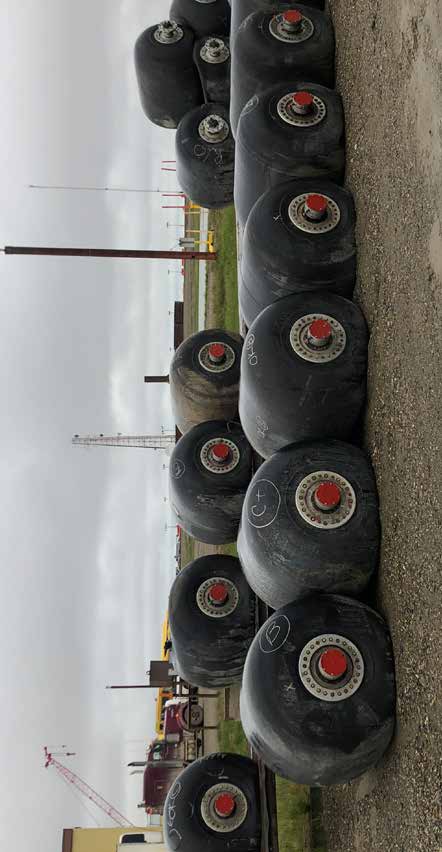

Customer Profile
This oilfield services company is located on the north slope of Prudhoe Bay, Alaska.

Application
The company owns 20 John Deere Model 6068/6090 Tier II & III Rolligons. These are custom-made to the tune of roughly $2 million each and are used for transporting drill rigs to remote sites in Alaska. Each Rolligon has 12 baghouse tires and 24 spherical roller bearings.

Challenge
Bearing failures can result from several different problems, including improper installation, poor design, misalignment, imbalance, overloading, environmental conditions, wrong lubricant selection, contamination, lubricant degradation, and lack of lubricant. However, 80 percent of bearing failures are caused by just three of those problems: wrong lubricant selection, lubricant degradation, and lubricant contamination. The most damaging contaminants are dirt and moisture.
The Rolligon roller bearings are subject to harsh environmental conditions in Alaska, including -60°F (-51°C) temperatures, extremely high loads, low RPM (8-10), dirt, moisture, and idle time. The grease in use was a mineral grade lithium thickened NLGI 2 EP grease that would wax up when exposed to freezing temperatures, allowing the oil to run out of the thickener and bearing, while at the same time allowing the ingress of dirt and moisture. This led to complete saturation of the bearing and housing, which in turn caused excessive rust, lubricant degradation, bearing starvation, and numerous bearing failures.

LE Solution
“Bearings can have an infinite life when particles larger than the lubricant film are removed,” according to SKF. Maximizing bearing life requires selecting the right lubricant based on load, environment, temperature and speed, as well as sealing out contaminants such as dirt and moisture. If the right quality and quantity of grease is applied, bearing failure can be significantly reduced, freeing up costly reactive labor hours and downtime.
Lubrication Engineers recommended Almaplex® Ultra-Syn Lubricant (1298), a heavy-duty synthetic NLGI 1 grease containing LE’s proprietary additives Almasol® and Quinplex®. This grease provides optimum performance under extreme operating conditions. It is an aluminum complex thickened grease made with an ISO 460 viscosity synthetic base fluid, a combination that provides high-temperature functionality, low-temperature pumpability, and excellent performance in the presence of water.

Results
The year before the company switched lubricants, they experienced 114 roller bearing failures in its Rolligon fleet. The year after switching to LE’s Almaplex 1298, that failure number was reduced to only 24 – a 73% reduction. At a cost of $1,450 per bearing and considering parts and labor, the company saved approximately $196,200.
With 90 fewer bearing failures per year, the table shows annual cost savings for parts, labor and downtime.