
Oil sight glasses reveal lubricant condition
Lubrication Engineers is an authorized distributor of high-quality, affordable Xtract® sight glasses. These easy-to-install sight glasses take the guesswork out of fluid lubrication management. The Xtract sight glass product line enables continuous visual monitoring of the clarity, color, sediment and water contamination levels of your lubricants. Some models even allow you to easily remove the water by draining it right out of the system. The variety of sight glass solutions available will help advance your lubrication reliability program to the next level.
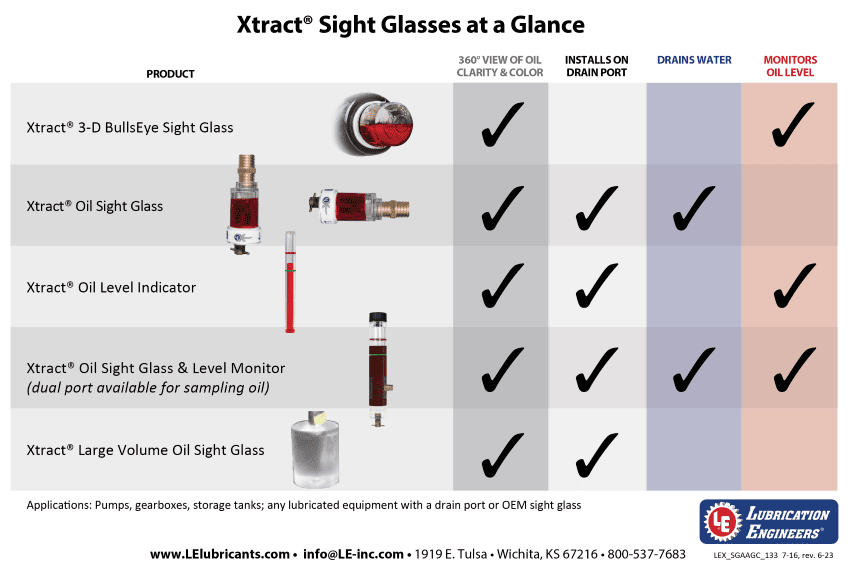
Xtract® Sight Glasses at a Glance
Xtract Oil Sight Glass
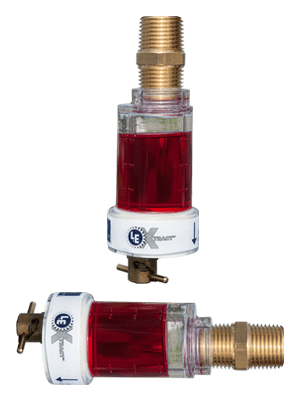
Xtract® Oil Sight Glass is suitable for most applications. Installed vertically or horizontally, it enables an immediate visual inspection of the oil. More importantly, this sight glass allows for the draining of any accumulated water, using the spring-loaded drain valve. The OSG can be installed directly to a drain port located at the bottom of a reservoir or with an elbow for drain ports located at the side of the equipment. The Xtract OSG is constructed of brass hardware (stainless steel optional) and a high performance polyamide bottle, capable of withstanding the pressure and temperature of most operating environments.
Xtract Large Volume Oil Sight Glass
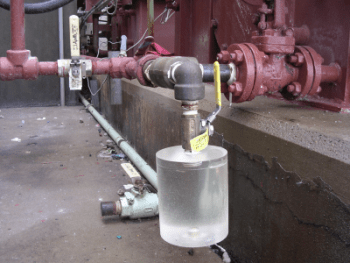
Perfect when high water volume accumulation is a problem, the Xtract® Large Volume Oil Sight Glass provides the extra storage necessary to hold a large amount of water until it can be drained between maintenance checks. It is used on equipment that requires regular high-pressure washdowns or has high condensation problems, where water contamination cannot be avoided or minimized.
Xtract Oil Sight Glass & Level Monitor
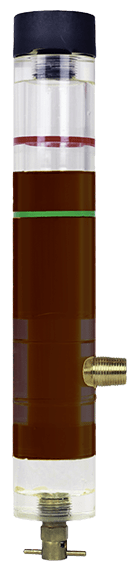
The columnar style Xtract® Oil Sight Glass & Level Monitor is the all-in-one solution, allowing operators to manage oil levels, visually inspect lubricant condition, and easily drain off any water. Red and green decals are included with the OSGL to mark upper and lower limits, or to designate running oil level and idle oil level. This clear acrylic vertical oil sight glass provides a highly visible 360-degree view of the oil and can be hooked up to a desiccant breather, making it a substantial upgrade from an old vented brass-and-glass sight gauge.
The dual port model has a second 3/8″ NPT thread at 180 to allow the installation of a drain valve or access to the oil reservoir utilizing a pitot tube and a pitot sample adaptor.
See models and sizes…
Xtract 3-D BullsEye Sight Glass
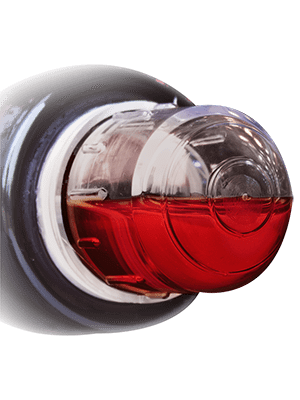
Used in conjunction with a standard OSG or alone on equipment where there is no water problem, the Xtract® 3-D BullsEye™ Sight Glass window is another Xtract tool that provides easy visual monitoring of oil.
Unless you are standing directly in front of them, old-fashioned sight plugs on oil reservoirs make it difficult to view the oil level. The glass stains easily and is partially obscured by the hardware around it. LE’s solution is the 3-D BullsEye Sight Glass. This one-piece cylinder, made of a high-performance transparent polyamide, allows immediate and accurate visual oil level monitoring from virtually any angle. Engineered to outperform and outlast traditional view ports, the inherently strong material provides excellent impact, chemical and UV resistance.
Xtract Oil Level Indicator
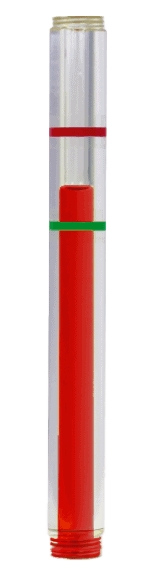
LE’s columnar style Xtract® Oil Level Indicator is recommended for monitoring the oil level inside large tanks, gearboxes or reservoirs when water contamination is not a problem. An old-style vented oil gauge made of brass and breakable glass can be replaced with an OLI (right), which is constructed of strong clear acrylic and provides a 360-degree view of the lubricant. In addition, you can attach a desiccant breather to the oil level indicator, an option not possible with the old style gauge.
The Xtract Oil Level Indicator can be used alone when there is no water problem or installed on equipment that also has a standard OSG. The sight glass allows the operator to visually inspect the condition of the oil and to take appropriate preventive action such as draining the water. The OLI is needed because the sight glass is situated too low to properly indicate oil level in this scenario.
LE offers full-service support for all Xtract sight glasses and other reliability solutions
In addition to onsite equipment assessment, consultation and service, LE provides the following customization and value-added options:
- Product recommendation, sizing and installation of oil sight glasses
- Lubrication reliability training & education
- Oil analysis program
LE is happy to offer industrial lubricant and reliability recommendations for a variety of industries and applications, and to provide product-specific data on all of our items to help you make the right decision. To learn more about our enhanced lubricants and lubricant reliability products, please contact LE today.